BUS News
Three Scholars Showcased Academic Excellence at the Outstanding Research Output Awards 2024/25
19 Jan, 2026
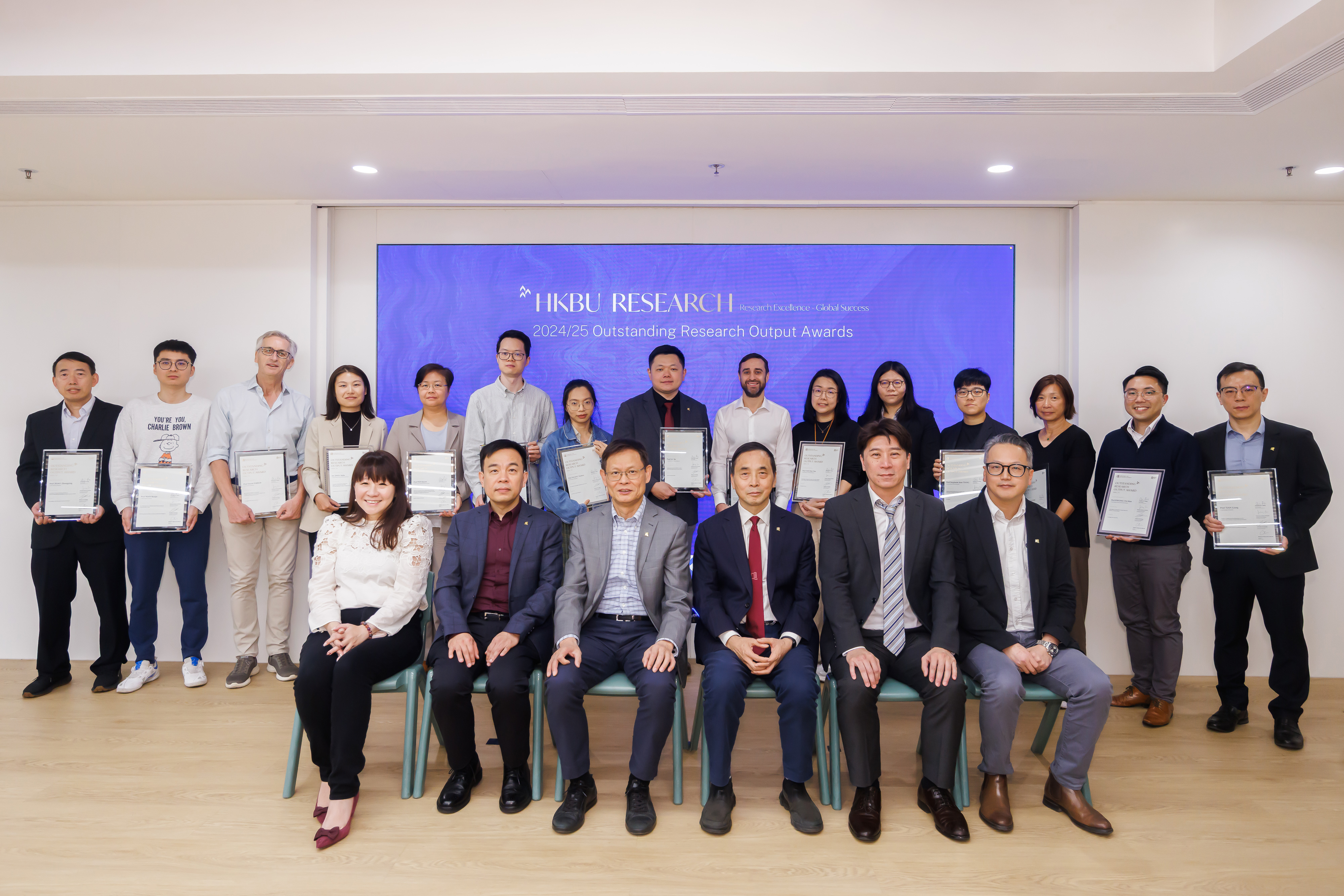
Three distinguished members from the School of Business were celebrated for their exceptional interdisciplinary research at the Outstanding Research Output Awards 24/25, held during the Awards Presentation and New Year Reception organised by the Research Office on 19 January 2026.
The awards recognise not only the originality and significance of research but also its academic rigour. The awardees are among 17 esteemed individuals in the HKBU research community honoured for their impactful contributions that shape the contemporary business landscape regarding social sentiments, consumer behaviour, and financial innovation.
In recognition of their achievements, each awardee received a certificate and a monetary prize of HK$50,000. The three award-winning research papers from the School exemplify the mission to advancing knowledge and enhancing academic reputation.
The awardees from the School, with their winning research papers, are:
Awardee: Professor Deng Huan, Assistant Professor, Department of Accountancy, Economics and Finance (AEF)
Research paper title: Structural Analysis of Xenophobia
Abstract: Addressing the surge in anti-Chinese xenophobia in the U.S. during the COVID-19 pandemic, this research applies a novel two-motivation framework to distinguish between the drivers of hostile behavior: intrinsic prejudice versus social-image concerns. By leveraging advanced data analytics and simulation modeling on a comprehensive survey of U.S. adults, the study uncovers a pivotal finding: the pressure to maintain a positive social reputation significantly outweighs private animus in curbing xenophobic actions. These results offer a transformative perspective for policy, demonstrating that establishing strong social norms against prejudice yields a far greater impact than interventions aiming solely to alter private attitudes.
Awardee: Professor Huang Yunhui, Assistant Professor, Department of Management, Marketing and Information Systems (MMIS)
Research paper title: Fast Fashion Consumption Signals Low Self‐Control
Abstract: The study argues that the fast fashion business model is defined by high trendiness, disposability, and unsustainable practices, leading to a perception of consumers as lacking self-control due to their short-term focus. A ChatGPT study and six experiments provide evidence of this relationship, revealing that fast fashion consumption negatively affects perceived self-control, mediated by the belief in a short-term focus. Serious fast fashion consumers are viewed as having lower self-control than casual consumers and compared to those of luxury and supermarket brands. This perception diminishes when sustainability cues suggest long-term thinking. The findings offer valuable insights for consumers and marketers regarding compatibility with self-control-related products and activities.
Awardee: Professor Zhang Jian, Associate Professor, Department of Accountancy, Economics and Finance (AEF)
Research paper title: Credit Information Sharing and Firm Innovation: Evidence from the Establishment of Public Credit Registries
Abstract: Public credit registries (PCRs) significantly enhance financing for innovative firms by facilitating credit information sharing, which reduces adverse selection and moral hazard. The study shows that the establishment of PCRs positively impacts firm innovation, particularly when it leads to increased bank debt financing and competition. This effect is stronger for opaque firms and those in innovation-intensive industries. Additionally, firms' efficiency in converting innovation inputs into outputs improves post-PCR establishment. Overall, the findings suggest that investing in credit information infrastructure like PCRs can accelerate economic growth and promote sustainable innovation, providing valuable insights for policymakers and lenders.
Professor Lyu Aiping, Vice-President (Research and Development), and Professor Zhang Han, Dean of School of Business, congratulated the awardees and look forward to reaching new heights in research excellence.